$0 Upfront Solar: What Connecticut Buyers and Sellers Need to Know
It started as a straightforward investment property purchase in Torrington.
A legal two-family with an accessory building, solid numbers, and motivated sellers. My clients had financing ready, a strong cash position, and a clear plan.
There was one wrinkle: leased solar panels on the roof.
Four months later, the deal was still alive — barely.
The sellers had stopped paying both the solar lease and the mortgage. My clients had advanced money out of their own pocket to prevent a double foreclosure. The solar company had filed for bankruptcy. And every transfer request had vanished into a black hole.
The deal closed in November. It should have closed in July.
Solar leases transfer cleanly every day in Connecticut. This one didn't — and understanding why matters before you're in the middle of a transaction.
What You're Actually Signing
When a solar company installs panels on your home at zero upfront cost, they own the panels. You own the roof they're sitting on.
Under a solar lease, you pay a fixed monthly payment — typically in the $120–$200 range for an 11kW system in Connecticut — regardless of how much power the panels produce.
Most leases include an annual escalator (1.9% - 2.9% is typical), meaning your payment increases every year for the life of the contract, usually 20–25 years.
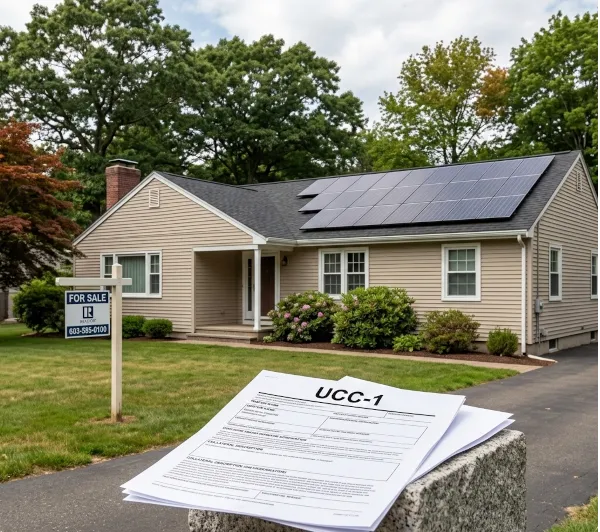
The solar company files a UCC-1 financing statement on your property to protect their asset. That filing shows up on a title search the same way a lien does.
A Power Purchase Agreement works differently — the billing structure is more complex and worth its own conversation. What matters here is that the company still owns the panels and still files a UCC-1 lien. The transfer and buyout mechanics at closing are the same.
In both cases, when you sell your home, the lease or PPA must either transfer to the buyer or get bought out at closing.
When it's handled early and managed well, it's a straightforward process.
When it isn't, it becomes the most complicated thing in the transaction.
Where Deals Break Down
The UCC-1 lien is the first problem.
When a title search reveals one — and it will — the lender flags it. Most lenders won't approve the loan until it's removed or made a lower priority lien than the new mortgage.
The buyer assumes the lease, the seller buys it out, or the deal falls apart.
The transfer process is the second problem — though it doesn't have to be. I've seen transfers completed in two weeks when the process is started early and managed closely. The problems start when nobody initiates it until after an offer is accepted.
There's a third problem most people don't see coming: the solar company itself can become a moving target.
When SunPower filed for Chapter 11 bankruptcy on August 5, 2024, its lease and PPA portfolio was sold separately from its brand. Complete Solaria paid $45 million for the SunPower name. A Hannon Armstrong affiliate called SunStrong Management paid $11.5 million for the actual customer contracts.
The people now collecting your monthly payment had nothing to do with your installation — and they carry none of SunPower's original warranties.
Four days before the bankruptcy filing, SunPower had quietly appointed a new billing sub-servicer called Launch Servicing. On September 20, 2024, they shut down all customer support channels simultaneously — the app, the web portal, the phone line.
Transfer requests went nowhere.
SunStrong Management's own CEO later described the backlog as "a perfect storm." (ABC15, April 15, 2025)
That's exactly what happened in Torrington.
The seller's attorney delayed initiating the transfer for weeks, insisting the buyer's side should start it. By the time anyone actually contacted SunPower, the bankruptcy had already been filed.
Meanwhile the sellers stopped paying.
Both the solar lease and the mortgage went delinquent. Two foreclosure proceedings opened. My clients advanced money out of pocket to keep the deal from collapsing, with the understanding they'd be repaid at closing.
Our attorney spent months negotiating with bankruptcy counsel and both foreclosure proceedings to hold everything together.
The deal survived.
Most people don't have a team that can hold a closing together through a bankruptcy and two simultaneous foreclosure proceedings.
What Sellers Are Actually Risking
If you're selling a home with a leased solar system, you're transferring a long-term financial obligation to your buyer. Or you're paying to exit it yourself. Either way, it costs someone something.
Buyout amounts vary by company and contract. For mid-term SunPower leases, the figure can reach $10,000–$15,000 or more depending on remaining term.
Talk to your attorney about how Connecticut's title requirements affect your options before you list, not after you're in contract.
The Connecticut Attorney General's office saw transfer complications coming. A consumer advisory issued in June 2022 — two years before the SunPower collapse — warned homeowners explicitly that those with leased panels or PPAs may have difficulty selling because both the buyer and the company need to agree to the transfer.
It didn't make headlines. It should have.
None of this is unsolvable. Sellers who know their contract terms, have a buyout number in hand, and start the transfer process before listing rarely run into serious problems.
The ones who don't are the ones who end up surprised at the closing table.
What Buyers Are Actually Taking On
For buyers, a well-functioning leased solar system on a home you love is not something to automatically avoid.
The math can work in your favor. If the panels are producing well, the lease payment is lower than what you'd pay Eversource for the same electricity, and the escalator stays below the rate of utility increases, you come out ahead.
But understand what you're committing to.
A solar lease transfers with the house and escalates every year. The 2.5% annual escalator sounds small. On a $150/month payment, it compounds to roughly $210/month by year 15 and $240/month by year 20.
That's a materially different number than what you see on day one.
For legacy SunPower leases specifically, buyers are also inheriting a system that may have no workmanship warranty.
SunPower's original 25-year "Complete Confidence" warranty has been effectively gutted by the bankruptcy. Component warranties from Enphase and Maxeon remain intact — but if something goes wrong with the installation itself — roof penetrations, wiring, mounting — there is no longer a clear backstop or single responsible party willing to step in.
That's the reality of inheriting a contract from a company that no longer exists in its original form.
How to Fix It Before It Becomes a Crisis
The fix is always the same: start early.
Sellers:
Pull your solar contract before you list.
Know your remaining term, your current payment, and your buyout figure.
Request an estoppel letter from the solar company confirming the balance, terms, and any transfer fees.
Get a buyout quote in hand before your first showing.
Buyers:
Request 24 months of production history and utility bills.
Understand what you're saving versus what you're committing to pay over time.
Provide terms of the lease to your lender - it may impact your buying power negatively
Include a contingency in the purchase agreement making the sale subject to successful lease transfer.
Both sides: Get an attorney involved early.
This is the Dream to Doorstep process on every home with solar panels — before a contract gets written, before a showing gets scheduled.
The Bigger Picture
Solar done right — owned outright or with a loan — is a genuine asset. It adds value, transfers cleanly, and gives the next owner something real.
The complications are specific to leased systems and the structural instability of the companies behind them.
SunPower is not the last solar company that will go bankrupt. Sunnova — another major residential provider — filed Chapter 11 in 2025 (EnergySage, June 9, 2025). SunStrong Management absorbed that portfolio too, making it one of the largest residential solar asset managers in the country with over 500,000 customers and 4 gigawatts of assets.
Solar adds complexity to a transaction whether you're buying or selling.
If you're trying to figure out what a leased system means for the value of a home or your next move, that's a conversation worth having before you're under contract.


