You Don’t Need a $2,000 Organizing Course — Just Three Boxes
You bought the bins.
The pretty ones with the labels. You watched the Netflix show. You even started color-coding something — shirts, toys, whatever.
Then life happened. Someone needed something. The phone rang. The day exploded.
And by Friday, those bins were buried under the same stuff they were supposed to organize.
Again.
So you went back online. Found the course. The one with worksheets and promises that this time would be different.
Except it wasn’t. Because the problem was never discipline.
The problem was that every system demanded perfect decisions right now — and you don’t have perfect decisions when you’re staring at a box of old photos at 9 p.m. wondering if keeping them makes you sentimental or just stuck.
Here’s what I know after 10 years watching people try to reclaim their space: You don’t need another system. You need permission to stop making every decision matter equally.
That’s what three boxes give you. And it costs nothing.
Why Every “Famous” System Leaves You Stuck
These aren’t bad methods. They’re just designed for people who already like organizing. Which probably isn’t you.
KonMari Method: Beautiful Until It Paralyzes You
“Does this spark joy?”
Sounds lovely. Works great if you’re sorting socks.
Falls apart completely when you’re holding your grandmother’s vase, wondering if guilt counts as joy, and you’ve been standing in this closet for 20 minutes without moving forward.
Decision fatigue kills momentum. That’s why people quit before they finish the first drawer.
Swedish Death Cleaning: Practical If You Enjoy Planning Your Own Estate Sale
The idea: sort through your stuff now so your kids don’t have to later.
Deeply thoughtful. Incredibly practical.
Also: emotionally crushing if you’re just trying to reclaim your guest room before Thanksgiving.
Most people need momentum, not mortality. This method assumes you’re ready for deep reflection. You’re not. You just want to find your kitchen counter again.
The Minimalist Game: Fun for Exactly 11 Days
Day 1: toss one item. Day 2: toss two. Day 15: toss 15.
Day 16: you’re Googling “does a pair of socks count as one item or two” and wondering if you can throw away individual batteries.
Day 30: you’ve given up entirely because the math feels like homework.
Gamification works until it doesn’t. And when it stops being fun, you stop doing it.
Clutterbug, FlyLady, The Home Edit: Beautiful Systems for People Who Love Systems
Color-coded bins. Zone schedules. Personality quizzes to determine your “organizing style.”
Gorgeous. Effective. And completely unsustainable if you have a full-time job, kids, or any form of decision fatigue.
These systems require ongoing maintenance, supplies, and emotional bandwidth. If you had that bandwidth, you wouldn’t be buried in clutter right now.
The Fatal Flaw They All Share
Every system I just described assumes you can make a thousand decisions today.
You can’t.
Not because you’re lazy. Not because you lack discipline.
Because no one’s brain can make a thousand emotional decisions in one sitting without breaking down.
They increase friction when what you actually need is permission to defer the hard calls and keep moving anyway.
That’s the only way regular people succeed.
The 3-Box Method: Free, Simple, and Built for Real Life
I didn’t invent the idea of using three boxes — variations of this method have been around for years.
What I refined, through countless real homes here in Connecticut, is how to make it work when life is messy: shorter sessions, a clear Decide Later box that removes guilt, and a focus on momentum instead of perfection.
Every time someone got stuck, it was the same problem: they couldn’t decide, so they stopped moving.
So I gave them permission to stop deciding.
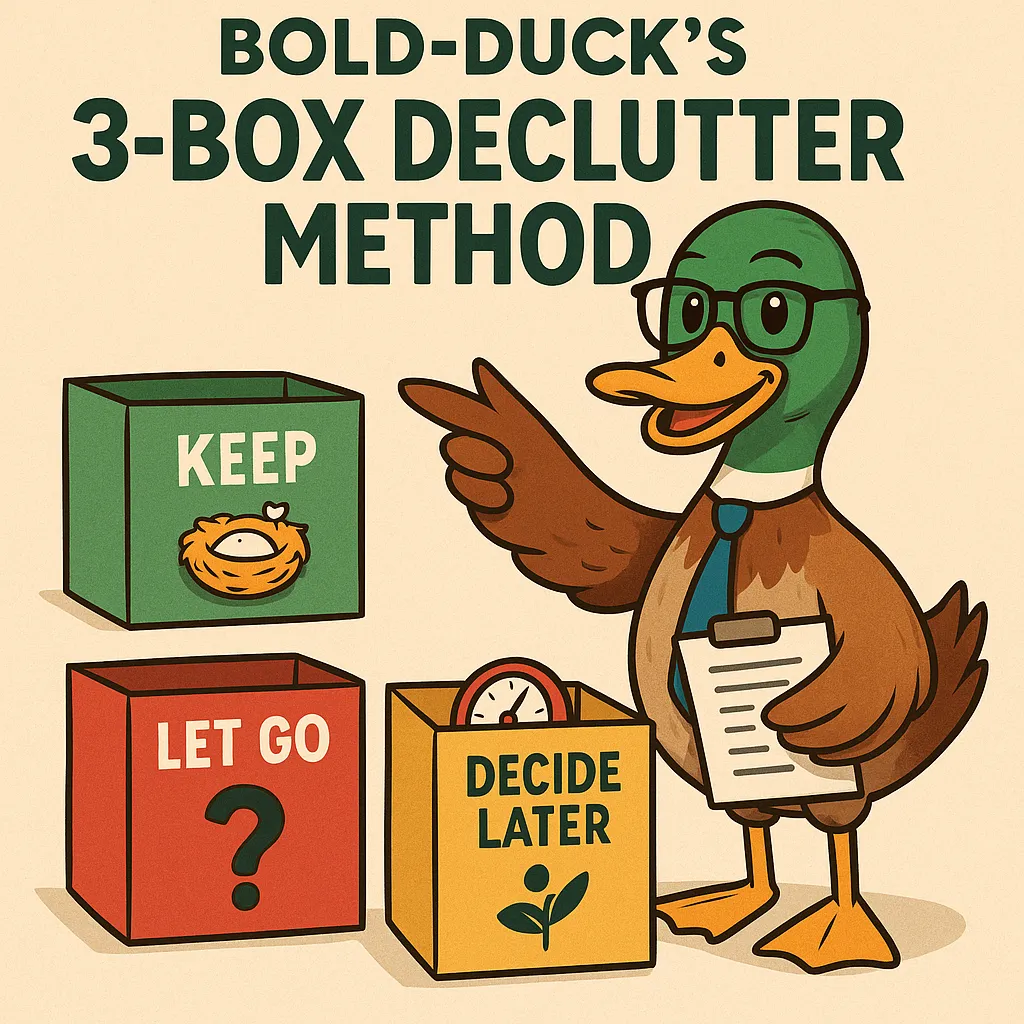
Three boxes:
Keep Box — Items essential for your life right now
Let Go Box — Items ready to donate, sell, or discard
Decide Later Box — Permission to postpone tough calls without losing momentum
That’s it.
No spreadsheets. No personality quizzes. No $79.99 subscription to unlock “advanced modules.”
Fifteen minutes. One drawer. Three boxes.
The Decide Later Box: Your Psychological Release Valve
This isn’t a cop-out. It’s the breakthrough.
When you hit a decision you can’t make, you don’t freeze.
You don’t spiral.
You don’t quit.
You defer it and keep moving.
You’re not avoiding the decision — you’re preserving momentum.
And momentum is what separates people who finish from people who give up on Day 3.
The 80 Percent Rule That Proves It Works
After watching hundreds of people seal Decide Later boxes, I noticed something.
Over 80 percent are never opened again.
Not because people forgot what was inside. Because once the pressure lifted, they realized they never actually cared.
The item wasn’t the problem. The decision was the problem.
Six months later, most people donate those sealed boxes without even looking inside. Because by then, they’ve already moved on — literally and emotionally.
It’s not hesitation — it’s the natural end of a decision you already made when you stopped needing what was inside.
How to Use It
What You Need
3 boxes or bags
Timer
Labels: “Keep,” “Let Go,” “Decide Later”
The Process
Pick your starting spot — bathroom drawer, coat closet, one kitchen cabinet (start small, not sentimental)
Set timer for 15 minutes
Sort rapidly — spend no more than 5 seconds per item:
• Need it now? → KEEP
• Ready to release it? → LET GO
• Not sure? → DECIDE LATER
Handle each box immediately:
• KEEP: Put back organized
• LET GO: Load in car for donation
• DECIDE LATER: Seal, date it, store it away
If most items land in Decide Later, that’s fine. Come back in a week. Decisions that felt impossible Tuesday often feel obvious the following Tuesday.
Track Wins, Not Perfection
You don’t need a coach. You need proof you’re making progress.
Mark it like this:
✅ First 15-minute session complete
✅ One full drawer cleared
✅ First Decide Later box sealed
✅ First donation run done
Most people clear their main living spaces within four weeks working just 15–20 minutes at a time.
Not because the system is complicated. Because it isn’t.
How It Plays Nicely With Every Other Method
Here’s the truth most system-sellers won’t tell you: the 3-Box Method makes every other method work better.
KonMari: Apply “does it spark joy?” when you review Decide Later boxes six months from now — once you can actually breathe and feel the answer instead of performing under pressure.
Swedish Death Cleaning: When sorting your Let Go box, ask: “Would someone I care about actually want this, or am I passing on my clutter disguised as sentiment?” That reframe cuts through guilt fast.
The Minimalist Game: Use Keep / Let Go / Decide Later as your daily structure so you’re not paralyzed wondering if socks count as one item or two.
Clutterbug, Home Edit, FlyLady: Save the pretty bins and zone schedules for after you’ve cleared space — not before. Systems work better when you’re not drowning.
Your three boxes become the entry ramp every method assumes you already have.
What This Actually Costs (Hint: Nothing)
Let me break down what you’re not paying for:
Organizing courses: $500 – $2,000+ for programs that assume you have time to watch 47 video modules
The Container Store binge: $300+ in bins before you’ve cleared a single drawer
Professional organizers: $75–$150 per hour to help you make decisions only you can make anyway
Subscription apps: $9.99 a month for “accountability” that’s really just guilt in digital form
Total saved: $800 to $3,000+ in the first year.
What you need instead:
Three boxes (cardboard works fine)
A timer
Fifteen minutes
That’s it.
Real Success Stories
Tom spent eight months researching decluttering methods without touching a single box.
His wife had been gone nearly a decade. His four kids had moved out long before that. And the house — 41 years of memories piled in the garage, basement, and attic — was swallowing him whole.
His friend Kelly, who’d been watching him avoid this for months, finally stepped up to help.
They started with the basement. Using the 3-Box Method, they worked one corner at a time — Keep, Let Go, Decide Later. No pressure. No guilt. Just forward motion.
When they finished, they stacked the Keep boxes at one end of the room and the Decide Later boxes at the other.
Then they tackled the attic. Cleared it in two weeks.
The garage? Three weekends.
By the time they were done:
7 truckloads to Goodwill
7+ truckloads to the dump
2 dozen Decide Later boxes (most filled with books Tom “couldn’t stand to part with”)
After we sold Tom’s house, he called me.
“What should I do with the Decide Later boxes? I don’t have room at my new place. And honestly… I can’t even remember what’s in them anymore.”
I smiled.
“That’s the point, Tom. Donate them.”
He did. All of them. Without opening a single one.
That’s not failure. That’s the system working exactly the way it’s supposed to.
The real reward isn’t an empty room.
It’s standing in that room and realizing the knot in your stomach is gone.
Clarity didn’t come from a $2,000 program or color-coded perfection.
It came from permission — to move forward without having all the answers, and to trust that most of what’s holding you back will resolve itself once you’re no longer buried.
You don’t need courage. You don’t need a guru.
You just need three boxes and the willingness to start imperfectly, today.
P.S. — Want free boxes delivered this week? Email me your address and I’ll ship ten quality boxes, no charge, no strings. Whether you’re clearing space to sell, to breathe, or to finally park in your garage again — I’m here when you need guidance on what’s next.
© 2025 Bolduc Realty Group. Adapted 3-Box approach refined through real client experiences. All Rights Reserved.


